

In the unfolding months of the Trump Administration, every action of theirs that challenges the elements that constitute American life raises a question: Are we a nation of people dedicated to equal rights, equal opportunity, freedom of expression in all its forms, justice for all, the rule of law, and the Constitution? Or are we individuals and companies devoted to profit, ideological purity, tribalism, loyalty to a leader, and reinforcement of our beliefs and desires no matter how delusional and cruel they might be?
Every day now and until the end of this administration, we must ask ourselves, our friends, family, neighbors, and colleagues this question. There is only one sensible, cohesive, and moral answer.
Yet some in the media, in the academy, in arts and entertainment, in business, and even in the legal profession have gone with surrender over resistance, supplication over defiance, ease over conflict, cowering over courage, and profit over principle.
When the Associated Press was banished from the White House Press room for refusing to refer to the Gulf of Mexico as Trump’s preferred Gulf of America, the rest of the White House Press decided to write a letter rather than stampeding out of the place. Meanwhile, AP has been banned from the White House Press Corps again.
When President Trump targeted law firms that represented clients who opposed Trump, pretending that these private firms were part of the “deep state” (the alleged “swamp” of lazy bureaucrats doing nothing or, worse, interfering with our lives), several of them, to avoid possible legal sanctions, gave in to Trump’s demands that they provide pro bono legal services to his administration. For example, the firm Paul, Weiss agreed to do $40 million worth of pro bono work and cease their DEI or “diversity, equity, and inclusion” policies. Likewise, Skadden, Arps agreed to $100 million in pro bono services, as did Wilkie Farr & Gallagher. Also caving this week, the law firms Kirkland & Ellis, Latham & Watkins, A&O Shearman, Simpson Thacher & Bartlett, and Cadwalader, Wickersham & Taft.
Why has the press remained quiescent when faced with Trump bullying? Why have law firms surrendered to his threats? Why have universities like Columbia given in to Trump’s demands to cease DEI policies or lose federal grants, a move that is surely unconstitutional? In all of these cases, was the rationale simply that they placed profit over principle, expediency over the core values? It certainly seems like it.
Let us consider DEI policies. These policies have been visibly active, for example, in many corporate offices, in the military, and in universities throughout the country. The idea seems laudable: to increase diverse faces and voices in workplaces, on battlefields, and in labs and classrooms; to make certain that no one is left out because of race, ethnicity, sexual orientation, opinions, and beliefs; and to make sure that in all of those settings, no one is treated unfairly. That is the meaning and purpose of DEI policies.

But the far-right has discovered something nefarious within these policies. They claim that organizations sponsoring and championing DEI are creating quotas for hiring minorities and women and that mediocre talents are hired instead of and promoted over more highly talented white men in particular and whites in general.
There might be isolated, individual cases where less qualified or less talented candidates are hired or admitted, and these are played up on right-leaning media. Yet, overall, such evidence is scant. Indeed, most studies show that rather than undermining the quality of institutions and programs, DEI practices enhance creativity, innovation, and the use of multifarious perspectives for problem-solving and decision-making. In the military, corporate and work spaces, and universities, DEI programs broaden and improve the pool of candidates rather than diminish it.
“Studies have shown that smarter decision-making and higher collective intelligence are more likely to occur in groups with ethnic and racial diversity as well as gender diversity. Ethnically and racially diverse groups think more accurately and produce fewer errors in scenarios, whether it is a jury deliberating over case facts or financial experts pricing stocks.”
The idea that white men are now the victims of bias and discrimination is mostly a red herring. As with claims of quotas and the hiring of mediocre talent over the more qualified leveled against DEI programs, there is no evidence of systemic discrimination against white men. Indeed, in most sectors of the media, academia, politics, finance, and corporate business white men still hold what might be described as disproportionate power and influence.
IF DEI PROGRAMS ARE WRONG, THEN THEIR OPPOSITE MUST BE RIGHT.
Do DEI programs need legal guidelines and procedural safeguards? Of course. But why does the far-right have such a problem with these programs, even in the face of such guidelines and safeguards? One glaring reason may be that white men fear change in their status and influence and find DEI programs to be an easy target, pretending that such programs use favoritism based on race, ethnicity, or sex in the place of merit.
Yet, if the right opposes DEI, then what do they prefer? They must prefer the opposite. Let’s confront the far-right by asking them to consider the opposite of each term. Diversity. What is its opposite? Homogeneity. If far-right persons oppose diversity, then they must be for homogeneity. We don’t need to be savants to see what homogeneous views they favor in order to protect white men.
How about inclusion? Its opposite is exclusion. Who is to be excluded? Given that DEI focuses on finding talent among those populations often left out, resource-deprived, and overlooked, far-right persons must want these populations excluded.
Finally, what about equity? It’s opposite is unfairness. Many far-right thinkers argue that equity means providing equal outcomes and ignoring individual differences. Christopher Rufo, for example, a crusader for school vouchers and ending public schools, believes that equity is a Marxist-based attempt to equalize outcomes for every race and gender by giving some unfair advantages rather than simply providing everyone equal opportunities. This view, of course, fails to take into account that some people lack the conditions whereby they can compete fairly, even when the opportunities are equal.
Another proponent of equity as equal outcomes is Jordan Peterson. A controversial public intellectual as well as a clinical psychologist, Peterson argues: “Equity means equality of outcome…Everything is equal, everything should be equally distributed, we should strive for equity. Wrong!” Yes, this is wrong. That is not what equity means.
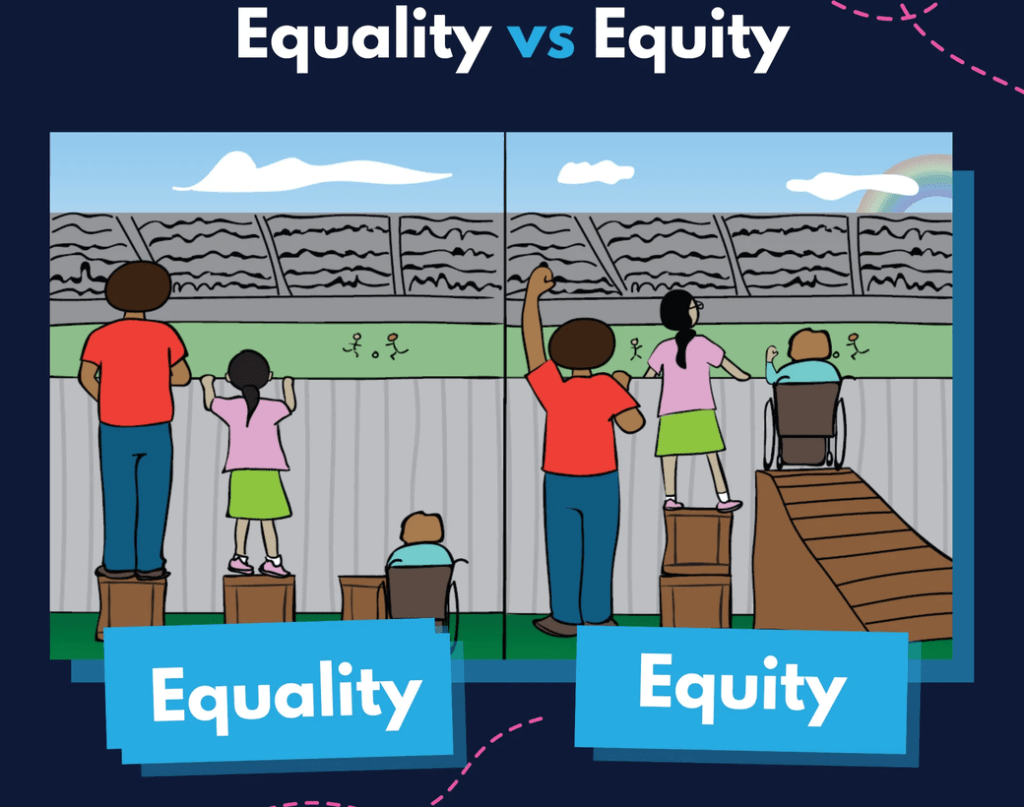
Equity is fairness. Rufo, Peterson, and their fellow travelers point to the ends of the spectrum but not the middle. No one on the left, where apparently the right-wing myth that equity as equal outcomes originated, argues for that. Instead, the argument on the left is that equity calls for equality of conditions. We strive to provide people with equal conditions under which they can operate to succeed or fail.
Almost all children in the United States have the equal opportunity to go to school. But no one would argue that the conditions in all of those schools are equal. If the state of Arizona, which ranks last in school funding among the 50 states, mandated that all public-school funding should be increased equally across every school district, would we expect that the historically under-funded schools in Tucson, for example, where one in four students lives in poverty, would catch up with the public schools in Scottsdale? We would not. Chronically under-funded schools need more funding to make up the differences, especially where the parental base can afford “add-ons” to make up for state-funding deficiencies.
Yes, an equal 10 percent increase in funding for each school district can make an appreciable difference in poor areas, but it is not sufficient to help those schools catch up to the wealthier districts. The poor districts need a greater increase to try to attain the equality of conditions, not outcomes, that can make equal opportunities more meaningful. Fairness or equity, then, requires Tucson’s impoverished students to receive more state funding than the students living in Scottsdale. Some students themselves living in Scottsdale might be poor, but in comparison with those in Tucson, their schools are not.
Equity requires uneven investment in order to be a fair investment if one district is trying to catch up to a more affluent district with far greater resources for their students. Likewise, Arizona cannot increase school funding by only 10 percent if it wishes to catch up with the school districts of Massachusetts, ranked first among the 50 states, holding in mind that funding is hardly the only reason for the ranking discrepancies.
So, here we are, early in the Trump reign, and our core values are in jeopardy. Honesty, decency, compassion, and even common sense are vanishing qualities in almost all Republican politicians and office-holders. Programs like DEI that enable the disadvantaged to progress; safeguards that protect our democracy and citizens’ rights; and values that make America a beacon of freedom, opportunity, and justice for the rest of the world are eroding, as civility transforms into servility. The heart of America is breaking.


 human-flourishing.blog